.svg)
.svg)
.svg)
%202.svg)

Why one hit isn’t enough: Portfolio strategy reshapes retention

.svg)
.svg)

Throughout the better part of a decade, the iGaming supply chain has found itself trapped in a cycle of speculative launches. The prevailing strategy among developers and operators alike has been to chase the elusive blockbuster release or the "hero game," as it is often dubbed. This single, massive title is designed to carry a studio’s reputation and an operator’s revenue for quarters at a time. It is a model that arguably relies too heavily on a single stroke of luck to sustain long-term business goals. In other words, building a strategy around the hope of catching lightning in a bottle.
However, in established and strictly governed environments, the vulnerabilities of the conventional approach are being exposed. When player acquisition costs skyrocket and channelisation approaches maximum capacity, relying on one marquee release to do the heavy lifting leaves vital retention on the table. To survive and expand today, the industry must fundamentally redirect its focus away from isolated game performance and toward intelligent, session-based content curation.
Nowhere is this redirection more evident than in Denmark. With channelisation exceeding 90%, the Danish market acts as the ultimate proving ground for European iGaming. Unlike emerging markets where operators can often rely on simple “spin-and-win” mechanics, Danish players exhibit sophisticated session behaviors. You cannot simply buy your way to growth with cheap traffic in an environment this developed; you have to earn every minute of player attention.
It is here that ELA Games recently deployed and measured a new approach to retention, proving that a diversified, strategically balanced portfolio dramatically outperforms the single-hit model.
The Anatomy of a Session
The most significant misconception operators hold about the slot segment involves measuring retention through individual game performance instead of looking at the overall lobby appeal. Operators frequently construct their lobbies as disjointed lists of "top-performing" titles, failing to account for the natural rhythm of a player's session. Evaluating a successful strategy goes far beyond looking at top-line revenue, requiring a deep dive into data points like session length, cross-game bet frequency, and the rate at which players move between different types of content.
In a developed market like Denmark, segmenting player cohorts by demographics falls short, demanding a deeper understanding of session intent. Needs fluctuate not just from month to month, but minute to minute. A player might log in seeking rapid, intense spins. Yet, forty minutes later, that same player will hit a wall. Modern players increasingly feel a natural sense of rejection toward more basic, amplified light and sound slot styles that they no longer associate with the word “game.” Providing a portfolio that anticipates this drop in interest by offering a natural change of pace—perhaps a game requiring more strategic decision-making or narrative engagement—keeps the player securely within the platform's walls.
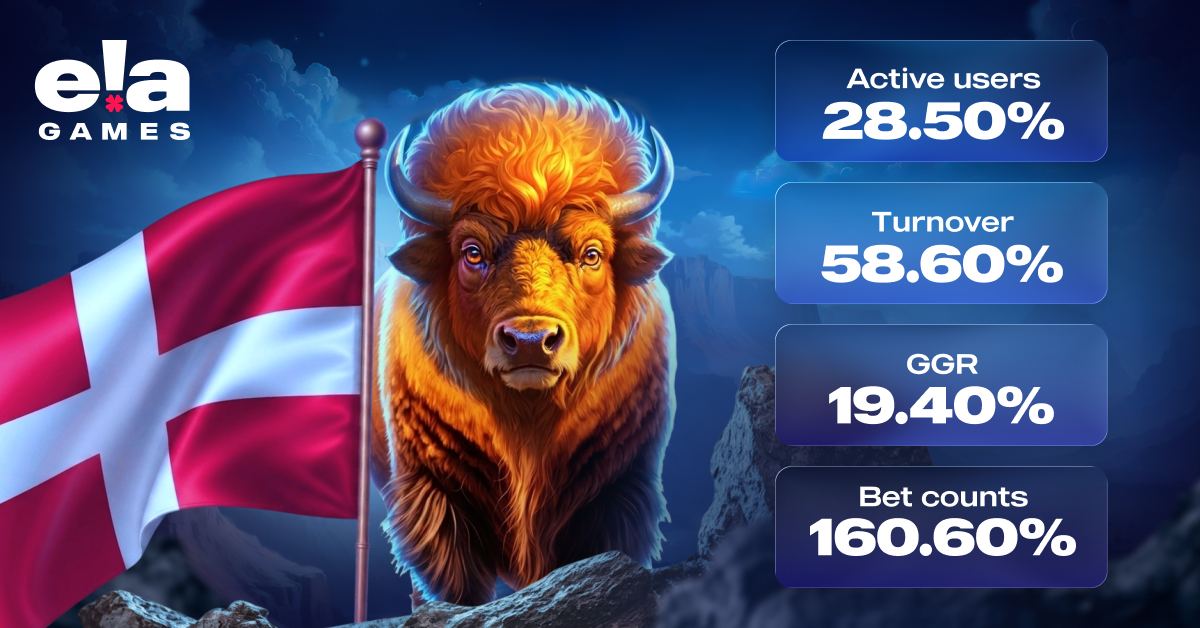
When ELA Games deployed this diversified portfolio strategy in Denmark, the commercial results clearly proved the concept. Because the growth was spread across multiple complementary titles catering to different play styles, the studio recorded a massive 160.6% surge in bet counts alongside a 58.6% increase in turnover across the market. This operational depth translated directly into a 28.5% rise in unique active users and a 19.4% bump in Gross Gaming Revenue (GGR).
Experiencing that kind of double-digit growth in a saturated market requires deliberate planning. It succeeds by comprehensively addressing the varying needs of different player cohorts, alongside the changing mindsets of individual players as their session progresses.
Volume and Depth in Practice
To understand how this curation functions in practice, we have to look at how ELA's specific games complement one another, acting as counterweights within the lobby.
Take Buffalo Force, for example. This title is purposefully designed to capture broad attention. It provides the highly recognizable, straightforward gameplay that serves as a brilliant acquisition tool. It catches the player who wants rapid spins, serving as the primary generator behind Denmark's massive spikes in turnover and bet counts.
While driving that initial volume is essential, maintaining momentum requires a completely different mechanism. This is where a title like Joker Winpot becomes critical. Joker Winpot relies on an unconventional 1x1 format alongside strategic gameplay that requires genuine player decision-making. It operates at a completely different pace, grounding the session and preventing players from burning out entirely.
Stepping back to look at the entire lobby, these two titles actually work together in perfect harmony. They catch players at different stages of their session progression. The player satisfies their initial desire for high-speed action on the rapid-fire reels of the broader acquisition release, then naturally moves to the complex, decision-based title for a longer, more intellectual session. The overall portfolio retains the player where an individual game would have lost them.
Strategic Demands for 2026
Such demanding player behavior forces a difficult conversation for the supply chain. Currently, suppliers tend to over-index in one of two directions: they either recycle familiar formats that offer no unique value to an operator’s lobby, or they focus so heavily on wild, complex innovation that they alienate the casual player at the expense of commercial performance.
A well-balanced slot portfolio in 2026 requires abandoning this binary thinking. It means finding the optimal ratio between straightforward, rapid-spin titles placed alongside deep, immersive games. Securing the right software is just the beginning; operators need to carefully map these different game types within their UI to naturally guide the player's journey from initial interest to sustained play. Equally critical is the realization that strict localization goes far beyond translating text. Denmark’s exceptional channelisation rate is hardly a fluke; it reflects a market where operators understand that a Danish cohort's tolerance for volatility, preferred visual styles, and session lengths will demand a completely different lobby arrangement than one built to engage players in Southern Europe.
Operators must begin thinking in terms of player journeys rather than product launches. Taking cues from the evolving behaviors in Northern Europe requires an updated strategy. Again, operators must construct a comprehensive, engaging environment instead of leaning on isolated blockbuster releases. As the digital space becomes increasingly contested and regulated, the operators who thrive will prioritize the entire lobby experience as heavily as they evaluate any individual game.
Looking ahead over the next 12 to 24 months, player expectations for dynamic, varied entertainment will multiply. As platforms integrate more personalized AI recommendations and gamification features, players will demand curated sessions that adapt to their moods in real-time. Consequently, building a diverse, interconnected catalogue of games will move from being a clever edge over the competition to becoming the absolute baseline requirement for keeping the doors open.


.webp)